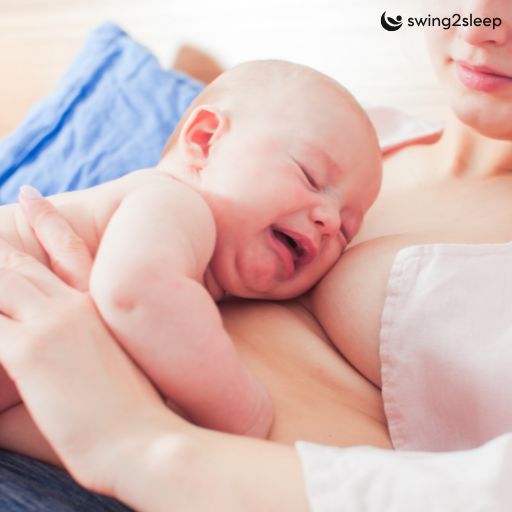


Particularly in connection with high-need babies, one term is heard and read time and again: KiSS syndrome. This refers to a misalignment of an infant's head.
Many parents wonder whether they have a high-need baby or if their baby might be suffering from KiSS syndrome. We summarize the symptoms, treatment options, and possible long-term consequences.
What is KiSS syndrome in infants?
The abbreviation KiSS stands for "Kinematic Imbalance due to Suboccipital Strain". According to representatives of alternative medicine, this is a movement disorder of the upper cervical spine.
It originates in the transition area between the base of the skull and the first cervical vertebra. Normally, the spine runs straight through the center of the body – from the tailbone to the skull. Infants suffering from KiSS syndrome repeatedly tilt their head to the side or even overextend it backwards (KiSS II).
In this video, you will find more interesting information on the subject:
Symptoms of KiSS syndrome
Not every baby who turns their head to the side suffers from KiSS syndrome. Parents often find it difficult to tell whether their child is simply looking to the side or actually has a misalignment of the cervical vertebrae. Before you visit a pediatrician, you should look out for the following abnormalities in your baby:
- Tilting of the head; usually one side is preferred when sleeping
- Sleeping posture (like a backward-bent "C")
- Weakness in holding the head
- Always the same head movements before falling asleep
- Asymmetry in the movements of arms and legs
- One-sided posture of the torso
- Movements only via one side (e.g., turning)
- Maturation problems of the hip joints
- Misalignment of the feet
- Flattened head, on one side or in the middle
- Hairless patch on the back of the head (symmetrical or asymmetrical)
- Asymmetry of the gluteal folds
- Skull asymmetry at the back of the head or in the face
- Increased drooling, problems swallowing, frequent vomiting
- Increased crying in the stroller or baby carrier
Affected children show a distinct asymmetry in body posture. Sometimes only the head is noticeably tilted to one side, in other cases the whole body appears asymmetrical, which is particularly evident when lying on the back. In some cases, even the face is affected by the asymmetry.
Then, under certain circumstances, one eye or an entire half of the face may appear significantly smaller. Children suffering from KiSS syndrome tilt their head far upwards and often overextend themselves as a result.
Many affected children find it uncomfortable when they are lifted or changed, they feel visibly uneasy in the stroller or car seat, and often prefer one side when breastfeeding. The babies express this discomfort by weeping or crying.
However, proving KiSS syndrome is difficult. Although the diagnosis is made by palpating the cranial joints and the cervical spine, X-rays are often also required. For this reason, and because scientific studies are lacking, this postural disorder is still disputed by many conventional medical practitioners.
Possible causes of KiSS syndrome
Various factors before and during birth are held responsible for KiSS syndrome. These include:
- Premature or prolonged labor
- Birth in breech or pelvic position
- Too little space in the womb
- Multiple pregnancies
- Vacuum extraction or forceps delivery
- Birth by C-section or emergency C-section
- Birth weight of more than 4 kg
Often, these factors cannot be prevented or avoided. Birth is an exceptional situation for both mothers and babies, associated with great stress. Current research assumes that the misalignment of the head and the upper cervical spine occurs during the course of birth and does not resolve itself on its own afterwards.
Critics argue, however, that vertebral misalignments are nothing unusual after birth and may well resolve themselves over time.

What are the potential long-term consequences of untreated KiSS syndrome?
If KiSS syndrome is not recognized and remains untreated, it can lead to numerous long-term consequences for affected children. These include functional disorders of the spine. Developmental delays cannot be ruled out either due to the blockage.
In childhood, learning and concentration difficulties, such as dyspraxia and dysgnosia, may also occur. Many children also show motor deficits, and asymmetry in the face and body can worsen with age because, in many cases, it has not "grown straight" on its own after all.
Other possible long-term consequences of untreated KiSS syndrome are aggressiveness, hyperactivity, behavioral problems, and headaches. Especially in adolescents who frequently suffer from headaches, an undiagnosed KiSS syndrome could be the underlying cause.
That is why early detection and timely treatment are so important here.
Are high-need babies perhaps in reality KiSS children?
The specific reasons why a child becomes a high-need baby have not yet been precisely clarified and can be diverse. One possible reason could certainly be KiSS syndrome, as painful misalignments, tension, and frustrating restrictions in movement are an absolutely plausible reason for loud and persistent protest.
It is always generally recommended to have potential causes for the baby's crying clarified by a pediatrician. This is because pain, digestive issues, or muscle tension might be the cause. Untreated KiSS syndrome can be associated with great stress for babies and children – if you have discovered a wry neck in your baby, you should have this suspicion investigated.
KiSS syndrome type 1 or 2?
In KiSS syndrome, a distinction is made between two categories: Type 1 and Type 2. Type 1 is characterized by the baby adopting a so-called "banana posture": it does not lie straight, but is always slightly curved.
This in turn leads to an asymmetrical head shape, breastfeeding problems, to sleep problems and persistent crying. A striking feature is the one-sided developmental delay.
With Type 2, on the other hand, the child repeatedly overextends backwards. In addition, the back of the head is slightly flattened. These babies do not like lying on their tummy at all.
In both cases, the head-holding muscles are too weak. The result is painful movement restrictions in various directions. There are also children who suffer from both KiSS types.
What therapies & treatment options are available?
After diagnosis, there are several options for treating KiSS syndrome. For example, atlas therapy on the upper cervical joint, which may only be performed by doctors, could be effective.
In this therapy, short impulses are applied to the muscles and ligaments at the transition from the head to the neck using the tip of the middle finger. This does not treat the actual misalignment, but rather has a positive effect on the perception of the body and pain. This is why it is considered particularly gentle and is perfectly suited for babies.
Osteopathic and chiropractic services can also release existing blockages in the joints of the cervical spine. As a result, symmetry can even be gradually restored.
Special physiotherapy, manual therapy, physical therapy or craniosacral therapy are also options for successful treatment.
Experts can often provide relief for the baby with just a few simple steps. After only a short treatment period, the crying phases become shorter and the sleep phases longer. Therapy usually only lasts a few weeks. The earlier affected parents take their baby to a specialist, the faster the symptoms associated with KiSS syndrome can be alleviated.

Osteopathy for babies
In the case of blockages, misalignments and tension, an appointment with an osteopath may also help babies. In osteopathy, various disorders are carefully felt with the hands and gently released, which is why this method is so well suited for children.
Osteopath Ralf Freitag from Hamburg explains exactly how this works in the following video.
KiSS syndrome: Not entirely without controversy
Many doctors who are exclusively influenced by conventional medicine consider KiSS syndrome to be a superfluous invention that can be used to make a lot of money.
While the problem that deformations and shifts can occur due to the heavy physical strain before and during birth is certainly recognized, it is assumed that these will resolve themselves over time.
Furthermore, they argue that the radiation exposure from a potential X-ray is unreasonable for the child and that manual treatments of the cervical vertebrae involve significant risks.
However, they primarily rely on the argument that there is a lack of reliable scientific studies. For this reason, it is also possible that health insurance companies will not cover the costs of treatment.
Conclusion: Treatment of KiSS syndrome can alleviate symptoms
A healthy baby is the most important thing for all parents. If you notice that your child is suffering from pain and there is no apparent cause, then a visit to an osteopath could provide clarification.
They can examine your baby and often diagnose a possible KiSS syndrome with just a few simple steps. No X-ray is necessary for this, and you do not subject your baby to unreasonable stress. Parents whose babies cry for unexplained reasons often want to leave no stone unturned to help their little darling.
So weigh up whether a visit to an osteopath or chiropractor is an option for you. Whatever you decide, the entire team at swing2sleep wishes you and your baby a speedy recovery and quick relief from all symptoms.
Automatic baby hammock from swing2sleep: Help your baby get better sleep
In the automatic baby hammock from swing2sleep, your baby automatically assumes an optimal lying position that supports the natural shape of the spine after birth. Just like in mommy's tummy, the back is rounded in the swing2sleep. Especially in the first weeks and months, this is the ideal sleeping position for the baby and promotes relaxed and restful sleep.
FAQ – KiSS syndrome and babies
How does a baby with KiSS syndrome behave?
Babies suspected of having KiSS syndrome often show a noticeable asymmetry in their posture. Typical signs include a preferred side of the head, a tilted head position, or significant overstretching backwards.
Many of these babies quickly appear dissatisfied, are difficult to calm, and cry more frequently, especially when being changed, carried, or in the stroller. Breastfeeding problems, restless sleep, or a dislike of the prone position can also occur.
Important: These signs are not definitive and can also have other causes. Professional clarification is therefore always advisable.
Is it normal for babies to sleep with an overstretched neck?
Occasional overstretching of the neck can certainly occur in newborns and is not automatically pathological. In the first weeks of life, muscle tension is still immature, and babies try out different postures.
However, if overstretching is observed frequently, appears painful, or is accompanied by intense crying, sleep problems, or clear asymmetry, it should be medically clarified. Persistent overstretching can indicate tension, discomfort, or in rare cases, a problem requiring treatment such as KiSS syndrome.
How do you recognize neurological disorders in babies?
Neurological disorders in babies are often difficult for parents to recognize because the nervous system is still developing and many behaviors are normal depending on age. However, persistent deviations in movement, muscle tension, or reaction can be conspicuous.
These include, for example, pronounced floppiness or severe stiffness, very one-sided movements, lack of eye contact, or hardly any reaction to sounds and touch. Unusually frequent, high-pitched crying or significant developmental delays can also be indications.
Important: Individual abnormalities do not automatically mean a neurological disorder. However, if there is uncertainty or if abnormalities persist over a longer period, this should be clarified by a pediatrician.
What are the 7 warning signs in a newborn?
In newborns, there are some signs that are considered possible warning signals and should be medically clarified, especially if they occur permanently or intensify:
- Very floppy or unusually stiff muscle tension
- Hardly any spontaneous movements or strongly one-sided movements
- Persistent, shrill, or unusually high-pitched crying
- Lack of or very little eye contact
- Difficulties with drinking, swallowing, or sucking
- Frequent severe overstretching or cramp-like movements
- Hardly any reaction to sounds, touch, or being spoken to
These warning signs serve as a guide and do not replace a medical diagnosis. Many babies show individual characteristics temporarily without a serious cause being present. However, if in doubt, it is always better to ask a doctor once more than to wait too long.