Zuletzt aktualisiert: Juli 2026. Verfasst von Maik Schwede, Gründer von swing2sleep.
Alles nur eine Phase! Eine Aussage, die wohl alle Eltern von Babys besonders während des ersten Jahres zu hören bekommen. In den ersten 14 Lebensmonaten durchleben Babys eine Entwicklungsphase nach der anderen – das kann für die Eltern eine echte Herausforderung werden. Doch die Wachstumsphasen und Entwicklungsschübe deines kleinen Wunders beginnen nicht erst, wenn es das Licht der Welt erblickt, sondern starten schon während der Schwangerschaft im Mutterleib. Dort werden die ersten Fähigkeiten wie Atmen und Schlucken trainiert und natürlich in einer beachtlichen Geschwindigkeit gewachsen. Doch welcher Entwicklungsschub deines Babys findet wann statt? Und welche neuen Fähigkeiten erlangt dein Baby im ersten Jahr? Wir haben uns die acht Wachstumsschübe beim Baby genauer angeschaut und kompakt für dich zusammengefasst.
Kurz zusammengefasst: Babys durchlaufen im ersten Lebensjahr acht Wachstumsschübe, etwa in den Wochen 5, 8, 12, 19, 26, 37, 47 und 55 (gerechnet ab errechnetem Geburtstermin). Jeder Schub bringt neue Fähigkeiten, dauert meist einige Tage bis Wochen und zeigt sich durch Unruhe, mehr Nähebedürfnis sowie verändertes Schlaf- und Essverhalten.
Das Wichtigste in aller Kürze
Entwicklungsschübe
Was sind Wachstumsschübe? Wann kommt es zu Wachstumsschüben? Wie kann man sie bei Eltern und Baby wahrnehmen?
Die 8 Wachstumsschübe im Überblick
Das Wichtigste zu jedem Wachstumsschub im Überblick: Was gibt es Neues, wie verhält sich dein Baby und wie kannst du ihm helfen?
Das Baby beim Wachstumsschub unterstützen
Was kann man als Eltern tun, um das Baby bestmöglich in den Wachstumsschüben zu unterstützen?
Entwicklungsschübe bei Babys im ersten Jahr
Wann kommt es zu Wachstumsschüben?
Jedes Kind ist anders, darüber müssen wir gar nicht diskutieren. Doch auch wenn die Entwicklung von Babys nicht nach einem strengen Zeitplan abläuft, gibt es Phasen, sogenannte Sprünge, in denen euer Baby neue Fähigkeiten erlangt und wichtige Entwicklungsschritte durchläuft. Meist geht das Ganze mit Wachstum einher, weshalb man auch von Wachstumsschüben spricht. Vielleicht erkennst du eine Veränderung im Verhalten deines Babys oder andere Anzeichen, die für einen Entwicklungsschub sprechen. Zur besseren Orientierung, wann du mit Sprüngen bei deinem Kind rechnen kannst, haben wir dir diese Baby-Schübe-Tabelle erstellt:
Baby-Schübe-Tabelle: Alle 8 Wachstumsschübe nach Wochen
| Schub | Zeitpunkt* | Das lernt dein Baby | Typische Anzeichen |
|---|---|---|---|
| 1. Schub | ca. Woche 5 | Wachere Wahrnehmung, erste Tränen, erkennt Lächeln | Mehr Weinen, sucht Nähe |
| 2. Schub | ca. Woche 8 | Sinneswahrnehmung (Sehen in Farbe, Hören, Tasten), hält Köpfchen | Erstes Fremdeln, Unruhe |
| 3. Schub | ca. Woche 12 | Erkennt fließende Übergänge und Muster im Tagesablauf | Braucht Rituale, quengeliger |
| 4. Schub | ca. Woche 19 | Dreht sich, orale Phase, erste Lautketten | Größerer Appetit, Schlaf unruhiger |
| 5. Schub | ca. Woche 26 | Erkennt Abstände und Zusammenhänge | Trennungsangst, will auf den Arm |
| 6. Schub | ca. Woche 37 | Kategorien verstehen, erste Worte verstehen, eigener Wille | Oft parallel Zahnen, schwierige Nächte |
| 7. Schub | ca. Woche 47 | Reihenfolgen verstehen, will am Alltag teilhaben | Bewegungsdrang, alles selbst machen |
| 8. Schub | ca. Woche 55 | Autonomiephase, großer körperlicher Sprung | Trotzmomente, veränderter Schlaf, mehr Hunger |
*gerechnet ab errechnetem Geburtstermin. Bei Früh- oder Spätgeburten verschieben sich die Schübe entsprechend.
Behalte alle Schübe im Blick: Hol dir den kostenlosen Meilenstein-Leitfaden für das erste Babyjahr. Mit allen 8 Schüben, Meilensteinen Monat für Monat und Ampel-System zum Abhaken.

Was sind Wachstumsschübe?
In den ersten 14 Monaten wird dein Baby acht wichtige Entwicklungsschübe durchlaufen. Vom hilflosen und unselbständigen Neugeborenen wird aus dem kleinen Baby Schritt für Schritt und Sprung für Sprung ein Kleinkind, das dir schon bald davonlaufen wird.
Schon im Mutterleib beginnt die geistige Reife deines Babys. Wenn du mehr über die kognitive Gehirnreife deines Kindes erfahren möchtest, findest du in unserem Blogbeitrag über die geistige Entwicklung von Babys alle wichtigen Infos. Wachstumsschübe bedeuten wichtige Entwicklungsschritte im ersten Jahr deines Kindes. Eine herausfordernde Zeit für Eltern, denn die Entwicklungssprünge der Babys, in denen das Gehirn deines Kleinen sprichwörtlich ein Update bekommt, gehen oft mit körperlichen Symptomen einher.

Wahrnehmung der Schübe – bei Eltern und Baby
Dass so ein Schub bei deinem Baby für euch Eltern eine anstrengende Zeit ist, steht außer Frage. Die Entwicklung, die dein Baby in Körper und Geist durchlebt, bringt körperliche Symptome wie Unruhe, Schlafprobleme, vermehrtes Schreien und verminderten oder gesteigerten Hunger mit sich. Dein Baby braucht jetzt viel Unterstützung, um den Wachstumsschub zu verarbeiten und muss stetig co-reguliert werden. Das kannst du beispielsweise durchs Tragen erreichen. In unserem Blogbeitrag Babys sind Traglinge kannst du dich leicht von den Vorteilen, die es mit sich bringt, Babys zu tragen, informieren.
Doch auch für dein Baby ist das Erlernen neuer Fähigkeiten anstrengend. In Rekordzeit müssen Körper und Geist mit all den neu erlernten Sinneseindrücken umgehen lernen und mehr als die Hälfte seiner Energie steckt der Körper deines Babys nun in den Ausbau der Gehirnstruktur, während das ganze neuronale System vernetzt wird. Dazu kommen Emotionen wie Trauer, Angst und Wut, die dein Baby nun ganz neu erleben und aushalten lernen muss. Umso wichtiger ist es, dass du diesen Phasen mit Verständnis und Geduld begegnest. Denn auch wenn es sich anfühlt, als könntest du es deinem Kind nicht recht machen, gibst du deinem Kleinen den nötigen Halt, um die neue Wahrnehmung zu verarbeiten.
Die acht Wachstumsschübe im Überblick
1. Wachstumsschub – der 5 Wochen Schub
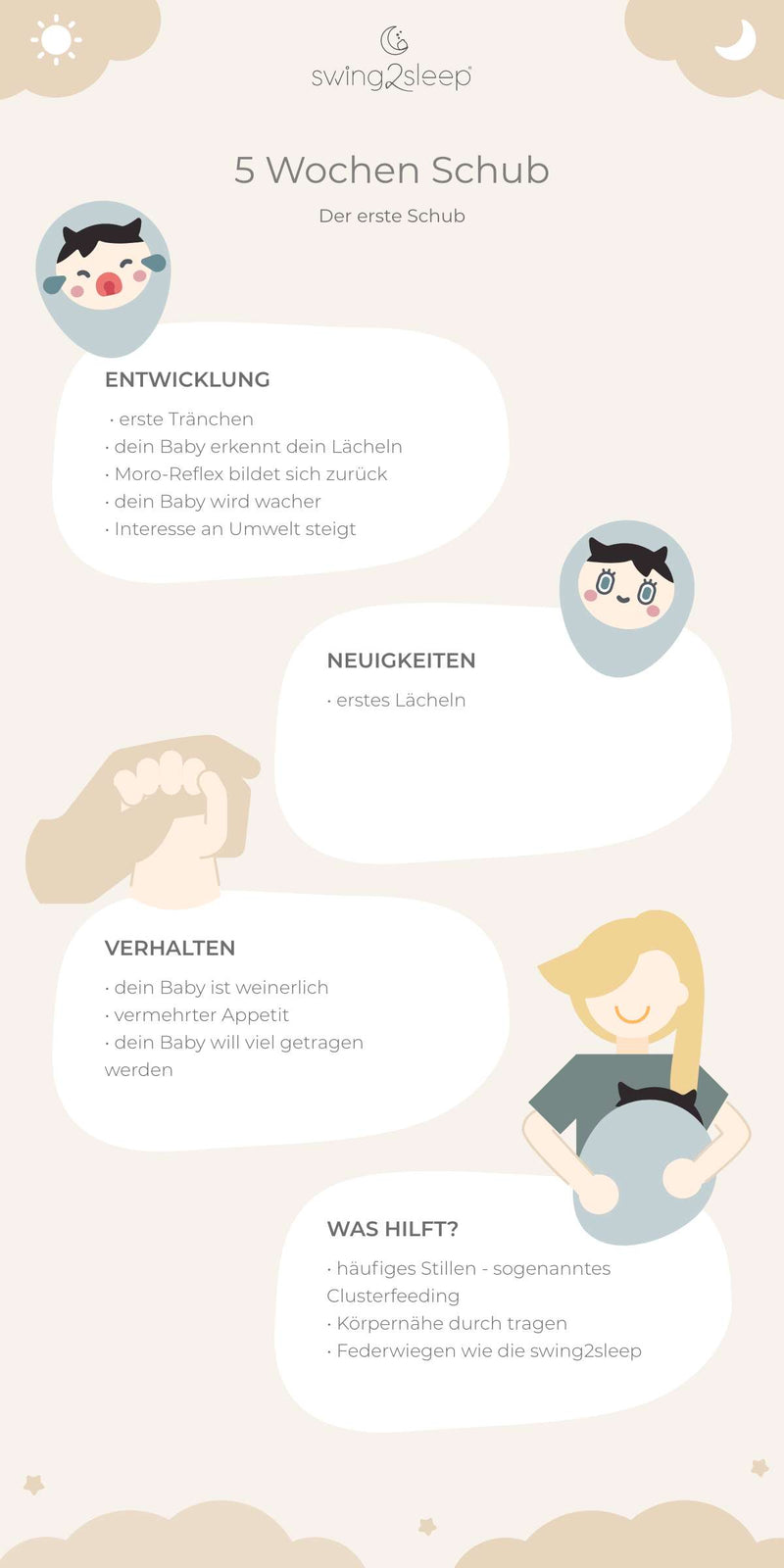
Schon etwa fünf Wochen nach der Geburt findet der erste Wachstumsschub beim Baby statt. Berechnet wird der Zeitraum ab dem berechneten Geburtstermin. Bei Kindern, die zu früh geboren werden oder später das Licht der Welt erblicken, verschiebt sich der Schub entsprechend. Im ersten Wachstumsschub bemerkst du vielleicht, dass sich die Wahrnehmung deines Kindes verändert – es wirkt wacher und beginnt, seine Umgebung und Umwelt zu entdecken. Wenn dein Baby weint, wirst du die ersten Tränchen entdecken können und dein Kind kann nun das Lächeln der Menschen in seiner Umgebung erkennen. Vielleicht kannst du auch schon das erste Lächeln deines Kleinen entdecken. Der Moro-Reflex, der für das Zucken im Schlaf verantwortlich ist, lässt langsam nach. Mehr zu dem Reflex erfährst du in unserem Blogbeitrag über frühkindliche Reflexe. Der erste Monat mit Baby ist magisch, denn du lernst dein kleines Baby ja erst kennen. Wenn du genauer wissen willst, was dein Baby im 1. Monat an Entwicklung durchlebt, findest du die passende Info auf unserem Blog.
2. Wachstumsschub – der 8 Wochen Schub

Ein Fest der Sinne: Im zweiten Wachstumsschub und gleichzeitig zweiten Lebensmonat verbessert sich die Sinneswahrnehmung deines Babys. Sehen, hören, riechen, schmecken, tasten – deinem Baby eröffnet sich eine komplett neue Welt, sogar in Farbe, und die Eindrücke müssen erstmal verarbeitet werden. Das ist auch die Zeit, in der das erste Fremdeln beginnen kann, schließlich erkennt dein Baby nun neue Menschen in seiner Umgebung und weiß sich bei dir und euch als Eltern in Sicherheit. In deinem Arm hin und her geschaukelt fühlt es sich vermutlich am wohlsten. Das liegt am vestibulären System, über das du auf unserem Blog mehr erfahren kannst. Abgesehen von dem geistigen Wachstum entwickelt sich auch der Körper deines Babys enorm. Nun kann es schon alleine sein Köpfchen halten und kann, wenn es zum Beispiel ein interessantes Geräusch hört, den Kopf in die richtige Richtung drehen. Außerdem entdeckt es seine eigenen Hände und Füße und trainiert seine Muskulatur, wenn es versucht, seine Füßchen zu erwischen. Hast du dein Baby schon mal an seinem Zeh lutschen sehen? Das liegt daran, dass dein Baby erkannt hat, dass Nuckeln nicht nur zur Nahrungsaufnahme dient, sondern auch herrlich beruhigend ist.
3. Wachstumsschub – der 12 Wochen Schub

Hast du bemerkt, dass dein Baby anfängt, vorbeifahrenden Autos hinterher zu schauen oder sich für sein Mobile zu interessieren? Das liegt daran, dass es nun mit 3 Monaten fließende Übergänge, also Objekte in Bewegung, besser wahrnehmen und begreifen kann. Jetzt ist der perfekte Moment, um Rituale, wie zum Beispiel zum Einschlafen, in euren Tagesablauf zu integrieren, denn dein Baby erkennt nun Muster im Tagesablauf immer besser. Feste Abläufe und Rituale helfen dabei, diese neuen Fähigkeiten zu verbessern und geben deinem Kind Sicherheit. Die Wahrnehmung deines Babys nimmt nun mehr und mehr zu. Es lauscht gespannt allen möglichen Geräuschen und trainiert seine Stimme durch Glucksen und Quietschen. In unserem Blogbeitrag Sprachentwicklung: Babys lernen spielend erklären wir dir nochmal genau, wie sich das niedliche Gebrabbel auf die Stimme auswirkt.
4. Wachstumsschub – der 19 Wochen Schub

Einmal nicht hingeschaut und zack – liegt dein Baby auf der Seite oder dem Bauch. So langsam wird dein Kleines mobil. Es erkennt nun auch, dass es fließende Übergänge beeinflussen kann, indem es einen rollenden Ball anhält oder eine Rassel schwingt und so Geräusche erzeugt. Jetzt musst du auch besonders aufmerksam sein, denn die orale Phase beginnt und dein Baby wird alles, was es in die Finger bekommt, auf direktem Wege in den Mund stecken. Hat dein Baby gerade Mama gesagt? Die ersten Laute werden in Reihe gebildet und mitunter kann es so klingen, als ob dein Kind schon Mama oder Papa sagt. Wir enttäuschen dich ungern, aber momentan übt es noch seine Stimme und kann noch nicht bewusst Wörter bilden. Zusätzlich zu seiner Entwicklung durchläuft der Körper deines Lieblings im vierten Monat einen großen Wachstumsschub. Vermutlich bemerkst du das vor allem am wachsenden Appetit, denn bald schon wird dein Kind bereit für Beikost sein.
5. Wachstumsschub – der 26 Wochen Schub

Während der 5. Monat deines Babys fast schon ruhig verlief, kannst du dein Baby nun kaum ablegen, geschweige denn den Raum verlassen, ohne dass ein Schrei-Konzert durch die Wohnung hallt? Das liegt daran, dass dein Baby nun Abstände erkennen kann und es sich unsicher und alleine fühlt, wenn seine Hauptbezugsperson den Raum verlässt. Wahrscheinlich fängt es nun an, auch gegenüber eigentlich vertrauten Personen wie den Großeltern, deinem Partner oder deiner Partnerin misstrauisch zu werden und will viel lieber auf deinen Arm. Eine frustrierende Zeit für alle Beteiligten, und doch ist es wichtig, dass ihr euer Baby nicht schreien lasst. Warum, erklären wir dir in unserem Blogbeitrag Babys schreien lassen? Gleichzeitig wird dein Kind anfangen, Zusammenhänge zu verstehen, zum Beispiel, dass ihr euch freut, wenn es winkt und klatscht oder dass ein Gegenstand, der runterfällt, ein Geräusch macht. Sein Interesse an der Schwerkraft wird dadurch geweckt und alle möglichen Dinge, Kisten und Schubladen werden ausgeräumt und herumgeworfen. Auf unserem Blog findest du weitere, nützliche Informationen über dein Baby im 6. Monat.
6. Wachstumsschub – der 37 Wochen Schub

Sicher hast du schon gemerkt, dass mit dem Eintritt des 7. Monats dein Baby mehr und mehr seinen eigenen Willen entwickelt und diesen auch lautstark kundtut. Immer ohne Worte zu erkennen, was dein Baby eigentlich gerade will, kann ganz schön kompliziert sein. Deshalb hat die Natur es geschickt eingefädelt, dass nun auch der Zeitpunkt gekommen ist, in dem einfache Worte von deinem Baby verstanden werden und es im 8. Monat eine große geistige Entwicklung hinlegt. Sind eure Nächte gerade herausfordernd, dein Baby sabbert vermehrt und hat ständig die Finger im Mund? Dann liegt es vermutlich daran, dass die Zähnchen beim Baby durchbrechen. Wie du deinem Kind jetzt helfen kannst, erfährst du in unserem Blogeintrag über Linderung des Zahnungsschmerzes. Auch Bücher beginnen deinem Baby nun Spaß zu machen, denn es kann Objekte jetzt in Kategorien einteilen: Ein Ball ist ein Ball, egal welche Farbe, Größe oder ob in einem Buch oder in der Realität.
7. Wachstumsschub – der 47 Wochen Schub

Der Schub in der 47. Woche wird auch als der Schub der Reihenfolgen bezeichnet. Dein Baby war in seinem 9. Monat mehr mit seiner geistigen Entwicklung beschäftigt, doch jetzt ist ein guter Zeitpunkt, deinem Baby zu zeigen, wie es sicher vom Sofa kommt oder Treppen am besten bewältigen kann, nämlich rückwärts. Außerdem möchte dein Kind nun mehr und mehr an eurem Alltag teilhaben, eine gute Gelegenheit, um mit Besteck beim Essen und Bechern zum Trinken anzufangen, aber auch, die Sprachentwicklung durch Unterhaltungen weiter zu fördern. Vermeide dabei unbedingt Babysprache, denn dein Kind profitiert viel mehr davon, die richtigen Wörter und Wortgruppen kennenzulernen. Spätestens jetzt ist auch der Zeitpunkt gekommen, in dem eure Wohnung absolut babysicher sein sollte. Dein Baby wird vermutlich nicht nur sitzen, sondern schon ziemlich zügig unterwegs sein und nun auch damit beginnen, überall hochzukrabbeln und sich hinzustellen – nichts ist mehr sicher. Manche Babys machen mit 10 Monaten schon die ersten, vorsichtigen Schritte. Das kann es, weil sich der tonische Labyrinthreflex nun nach und nach zurückbildet – lies doch mal unseren Blogbeitrag zum Thema.
8. Wachstumsschub – der 55 Wochen Schub

Der 11. Monat von Babys ist voller Bewegung und Aktivität, voller erster Male und besonders körperlicher Entwicklung. Um den ersten Geburtstag verzweifeln viele Eltern dann regelrecht am Verhalten ihres Babys, denn die Autonomiephase trifft sie mit voller Wucht. Dein Baby will alles alleine machen, auch dann, wenn es motorisch noch nicht dazu in der Lage ist. Die kaputte Banane oder der falsch geschnittene Toast, das Gefühl, alles falsch zu machen – bekannte Klassiker, die sich in so gut wie jedem Haushalt abspielen. Doch keine Angst, auch hier handelt es sich lediglich um eine Phase, die für den Entwicklungssprung, in dem sich das Kind gerade befindet, wichtig ist. Ein veränderter Schlafrhythmus und Probleme, wenn es zur Schlafenszeit kommt, sind keine Seltenheit, denn Kinder haben insbesondere während dieses Schubs große Angst, etwas zu verpassen. Das Gehirn wächst während dieses Wachstumsschubs und der Kopfumfang vergrößert sich sichtlich. Vermutlich hat dein Kind gerade auch mehr Hunger und fängt an, mit Essen zu spielen. Mehr Informationen zum 12. Lebensmonat findest du auf unserem Blog.
Häufige Fragen zu Wachstumsschüben
Wie lange dauert ein Wachstumsschub beim Baby?
Die meisten Wachstumsschübe dauern einige Tage bis etwa eine Woche. Spätere Schübe (ab Woche 26) können sich über mehrere Wochen ziehen, weil die Entwicklungsschritte komplexer werden. Jedes Baby hat sein eigenes Tempo. Die Wochenangaben sind Orientierung, kein Zeitplan.
Woran erkenne ich, dass mein Baby einen Schub hat?
Typische Anzeichen sind ein erhöhtes Nähebedürfnis, mehr Weinen und Quengeln, unruhigerer Schlaf sowie verminderter oder gesteigerter Hunger. Oft wirkt dein Baby anhänglicher als sonst und lässt sich schwerer ablegen, meist kurz bevor eine neue Fähigkeit sichtbar wird.
Warum schläft mein Baby im Wachstumsschub so schlecht?
Das Gehirn deines Babys verarbeitet im Schub enorme Mengen neuer Eindrücke. Mehr als die Hälfte seiner Energie fließt jetzt in den Ausbau der Gehirnstruktur. Diese Reizverarbeitung macht das Ein- und Durchschlafen schwerer. Co-Regulation durch Nähe, Tragen und sanftes Schaukeln hilft deinem Baby, zur Ruhe zu finden.
Was hilft meinem Baby während eines Wachstumsschubs?
Am meisten helfen Nähe, Geduld und verlässliche Rituale: Tragen, Körperkontakt, gleichbleibende Einschlafabläufe und ein reizarmes Umfeld. Dein Baby braucht dich jetzt als sicheren Hafen. Verwöhnen kannst du es in dieser Phase nicht.
In welchen Wochen kommen die Wachstumsschübe?
Die acht Schübe kommen etwa in den Wochen 5, 8, 12, 19, 26, 37, 47 und 55, gerechnet ab dem errechneten Geburtstermin. Bei Frühgeborenen verschieben sich die Zeitpunkte entsprechend nach hinten, bei später geborenen Babys nach vorne.