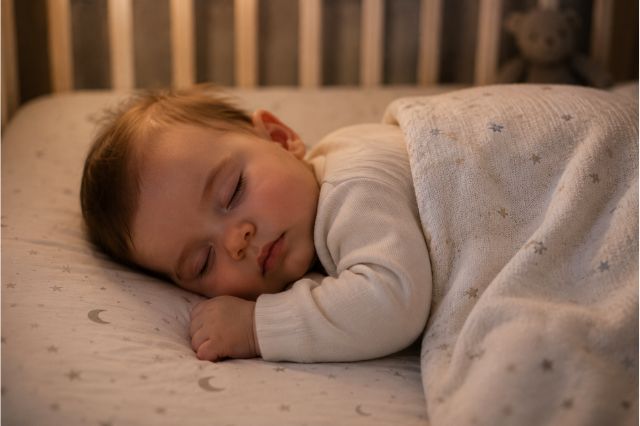
Has your baby already slept through the night or for several hours at a time and now suddenly wakes up again and refuses to nap? It is quite possible that this is a sleep regression. This refers to a period of poor sleep in a baby or toddler, which usually occurs in the first two years of life.
Sleep regression in babies occurs in several phases, with the so-called 4-month sleep regression being particularly well-known. But what is behind it? Why does sleep regression occur in your baby at all? And is there anything parents can do during this difficult phase? We have summarized the answers to these and many other questions for you in this article.

What is a sleep regression?
The term sleep regression describes various phases in your baby's life that can occur at around 4, 8, 12, and 18 months. During this time, your baby suddenly sleeps noticeably worse than before, even if they may have already been sleeping through the night – their sleep behavior suddenly changes. Your child then has great difficulty falling asleep and waking up at night is not uncommon: sometimes they even wake up every hour. It can take a long time before they find their way back to sleep, and the lack of sleep also affects you as parents.
And generally, during these sleep regression phases, your baby has trouble finding peace and regulating themselves. This can be quite grueling for parents, but also for the baby. The good news, however, is: sleep regression is only a phase of poor sleep in a certain month of life, not a permanent state.
Phase of sleep regression: Not a step back, but progress
Since "regression" translates to a step backward, the term is actually not quite accurate. Although the sleep rhythm deteriorates again, your child is actually making great progress in terms of development during these sleep-stealing phases. Sleep regression usually occurs with an enormous growth and development spurt.
Your child is learning new motor and cognitive skills – more than they can take in at once. The newly learned information is stored in long-term memory during sleep. In addition, it often happens that babies try to repeat and practice the newly learned movements in their sleep. All of this then sometimes manifests itself in changed sleep habits or your baby even has real sleep problems. Sometimes sleep regression in babies is further intensified by teething.
In such restless phases, the automatic baby hammock from swing2sleep can help you. You place your baby in your hammock: there they lie closely embraced as if in the womb. This feeling of security and safety can help your baby to calm themselves and find a relaxed sleep. This makes our miracle hammock a very great help during sleep regression.

How does sleep regression manifest in babies & toddlers?
If the newborn suddenly sleeps worse, it is no cause for concern, but rather a sign that your baby is developing well. However, if you are unsure whether it is currently a phase of sleep regression, check your child's behavior for these three typical signs and changes:
- Difficulty falling asleep: The process of falling asleep takes a long time during the day, but also in the evening, and your child has trouble settling down or finding sleep. If your baby has already developed the ability to fall asleep on their own, this may have changed again. In addition, your baby seeks more closeness to you as parents and shows separation anxiety.
- Frequent waking: Your child no longer sleeps through the night and wakes up more often. For example, they may only sleep for 60 to 90 minutes at a time. Your baby also suddenly no longer likes their nap, it is shorter or even skipped completely.
- Strong restlessness: Your baby fidgets and kicks a lot, is more fussy and cranky than you are used to from your little one, and cries more often. This is the result of poor sleep.
How long does an episode of sleep regression last?
Well, unfortunately, that's not so easy to answer. Because the old wisdom also applies here: every child is different. Some babies can sleep wonderfully again after just a few days, for others it takes a little longer until the brain has gotten used to the changes in the body.
In addition, the duration of the sleep regression also depends on the age of your little one. For example, the phase of poor sleep at the age of about 4 months is significantly shorter than all other phases: about two to six weeks. Therefore, keep in mind when a sleep regression can occur. However: the month specifications are only guidelines. Of course, the individual development of your little one plays a decisive role.
Do you think your baby is in a phase of sleep regression? For many babies, the use of the swing2sleep has already worked wonders. Our miracle hammock offers your baby a cozy nest and rocks them to sleep with gentle movements. These help your baby to fall asleep more easily and also promote sleeping through the night. If your baby has difficulty settling down, the closeness in the cozy hammock will have a positive effect on their state of mind.
4-month sleep regression
- The first growth spurt is coming up
- The baby learns to roll from their stomach to their back and vice versa and practices this in their sleep – a new sleep pattern emerges
- Babies refine their motor skills, learn to grasp, and the oral phase also begins
- Sleep phases and deep sleep phases gradually become longer, which is unusual for your baby – when transitioning to the next sleep phase, these could be the reasons for the little one's sleep problems
8-month sleep regression:
- Gross motor skills deepen, your baby learns to crawl and pull themselves up independently
- They now recognize animals, people, and things – and divide them into categories
- In addition, your child learns certain sequences and routines in the daily routine
- All of this results in poorer and restless sleep
12-month sleep regression:
- Your child learns to connect things, for example, making animal sounds when they are pictured in a book
- Possibly the first attempts at walking are coming up, and your baby is now actively crawling and pulling themselves up independently
- Your baby gets their first teeth, which also causes poor sleep
- In addition, separation anxiety occurs, for example, during the settling-in period
18-month sleep regression
- The toddler learns to see themselves as an individual and develops self-awareness
- The "no" phase begins, your child realizes that they have their own will
- The vocabulary grows and your child now understands much of what you say
- Great urge to explore
- In this phase, the first nightmares in your child's life occur
Sleep regression in babies: Tips for parents
The bad news first: usually, parents and babies just have to get through the phases of sleep regression. After a few weeks, improvement usually occurs all by itself. A few things can also help:
- A regular daily routine: Of course, you can't make every day the same. There are usually too many responsibilities and to-dos in everyday life for that. However, you should maintain certain regularities. The same rituals in the morning, the same bedtimes, and an evening bedtime ritual – be it with a book, carrying, acupressure for falling asleep, or a lullaby.
- Create a healthy sleep environment: This helps especially in the evening to make falling asleep easier. Pay attention to dimmed light, how you dress your baby at night, and what the temperature in the room is. You should better avoid distracting things in the crib, such as stuffed animals or a mobile.
- Give closeness and have patience: Because in the phase of sleep regression, your baby usually just needs you or you as parents. So cuddle a lot with each other and carry your child if they ask for it.
- Rely on smart helpers: Especially for daytime sleep, the swing2sleep automatic baby hammock is ideal for quickly and safely rocking your child to sleep. And in the evening, some parents also use our miracle hammock with its gentle up and down movements to get the child to fall asleep. Once they are in a deep sleep, your baby can be carefully moved to the crib.
If your baby is suddenly frequently plagued by sleep problems and is in a sleep regression, you should respond to their needs as best as possible. Our automatic baby hammock helps not only during the 4-month sleep regression: whenever your baby has problems falling asleep, sleeping through the night, or settling down, our miracle hammock can help.

Sleep deprivation is like torture: But it gets better
We know: it can be enormously nerve-wracking when your child's sleep phases are short again and the nights bring little recovery. If your baby wakes up quickly, cries all night, and doesn't find their way to sleep, it can be very stressful.
The good news, however, is that all of this will pass. If you feel that everything is getting too much for you due to extreme exhaustion, do not hesitate to get help. This is never a sign of weakness, but always of self-care.