It's just a phase! A statement that probably all parents of babies get to hear, especially during the first year. In the first 14 months of life, babies go through one developmental phase after another – this can be a real challenge for parents. But the growth phases and developmental leaps of your little miracle don't just begin when it sees the light of day, but already start during pregnancy in the womb. There, the first skills such as breathing and swallowing are practiced and, of course, growth occurs at a remarkable speed. But which developmental leap of your baby takes place when? And what new skills does your baby acquire in the first year? We have taken a closer look at the eight growth spurts in babies and summarized them compactly for you.
The most important things in brief
Developmental leaps
What are growth spurts? When do growth spurts occur? How can they be perceived by parents and baby?
The 8 growth spurts at a glance
The most important facts about each growth spurt at a glance: What's new, how does your baby behave and how can you help?
Supporting the baby during a growth spurt
What can parents do to support the baby as best as possible during growth spurts?
Developmental leaps in babies in the first year
When do growth spurts occur?
Every child is different, there's no need to argue about that. But even if the development of babies does not follow a strict schedule, there are phases, so-called leaps, in which your baby acquires new skills and undergoes important developmental steps. Usually, the whole thing goes hand in hand with growth, which is why they are also called growth spurts. Perhaps you recognize a change in your baby's behavior or other signs that suggest a developmental leap. For better orientation as to when you can expect leaps in your child, we have created this baby spurt table for you:

What are growth spurts?
In the first 14 months, your baby will go through eight important developmental leaps. From a helpless and dependent newborn, the little baby becomes, step by step and leap by leap, a toddler who will soon be running away from you.
The mental maturity of your baby begins already in the womb. If you want to learn more about the cognitive brain maturity of your child, you will find all the important information in our blog post about the mental development of babies. Growth spurts mean important developmental steps in the first year of your child. A challenging time for parents, because the developmental leaps of babies, in which your little one's brain literally gets an update, are often accompanied by physical symptoms.

Perception of the spurts – by parents and baby
There is no question that such a spurt in your baby is a stressful time for you parents. The development that your baby experiences in body and mind brings physical symptoms such as restlessness, sleep problems, increased crying and decreased or increased hunger. Your baby now needs a lot of support to process the growth spurt and must be constantly co-regulated. You can achieve this, for example, by carrying. In our blog post Babies are carried beings, you can easily inform yourself about the advantages of carrying babies.
But learning new skills is also exhausting for your baby. In record time, the body and mind must learn to deal with all the newly acquired sensory impressions, and more than half of your baby's energy is now put into the expansion of the brain structure while the entire neuronal system is being networked. In addition, there are emotions such as sadness, fear, and anger that your baby must now learn to experience and endure for the first time. It is all the more important that you meet these phases with understanding and patience. Because even if it feels like you can't do anything right for your child, you are giving your little one the necessary support to process the new perception.
The eight growth spurts at a glance
1st growth spurt – the 5-week spurt
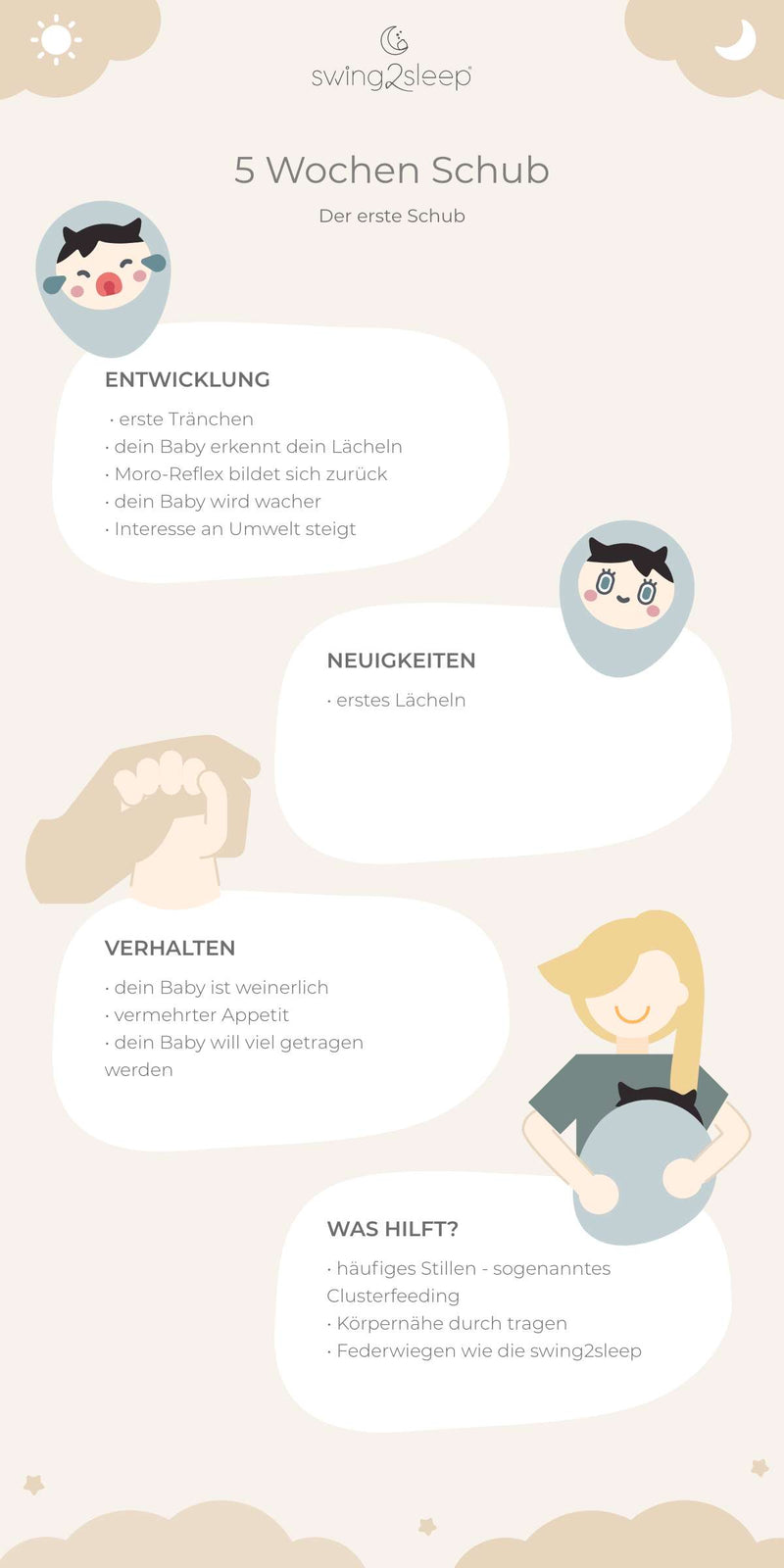
Already about five weeks after birth, the first growth spurt takes place in the baby. The period is calculated from the calculated due date. For children who are born prematurely or see the light of day later, the spurt shifts accordingly. In the first growth spurt, you might notice that your child's perception changes – they seem more alert and begin to discover their surroundings and environment. When your baby cries, you will be able to discover the first little tears, and your child can now recognize the smiles of the people around them. Perhaps you can already discover your little one's first smile. The Moro reflex, which is responsible for twitching during sleep, slowly subsides. You can find out more about the reflex in our blog post about early childhood reflexes. The first month with a baby is magical because you are just getting to know your little baby. If you want to know more precisely what development your baby goes through in the 1st month, you will find the relevant info on our blog.
2nd growth spurt – the 8-week spurt

A feast for the senses: In the second growth spurt and simultaneously the second month of life, your baby's sensory perception improves. Seeing, hearing, smelling, tasting, touching – a completely new world opens up to your baby, even in color, and the impressions must first be processed. This is also the time when the first stranger anxiety can begin; after all, your baby now recognizes new people in their environment and knows they are safe with you as parents. Rocked back and forth in your arms, they probably feel most comfortable. This is due to the vestibular system, which you can learn more about on our blog. Apart from mental growth, your baby's body is also developing enormously. Now they can already hold their head on their own and can, for example, turn their head in the right direction if they hear an interesting sound. In addition, they discover their own hands and feet and train their muscles when trying to catch their little feet. Have you ever seen your baby sucking on their toe? That's because your baby has realized that sucking is not just for food intake, but is also wonderfully calming.
3rd growth spurt – the 12-week spurt

Have you noticed that your baby is starting to watch passing cars or taking an interest in their mobile? This is because at 3 months, they can now better perceive and understand smooth transitions, i.e., objects in motion. Now is the perfect time to integrate rituals, such as for falling asleep, into your daily routine, as your baby is now recognizing patterns in the daily routine better and better. Fixed routines and rituals help to improve these new skills and give your child a sense of security. Your baby's perception is now increasing more and more. They listen intently to all kinds of noises and train their voice through gurgling and squeaking. In our blog post Language development: Babies learn through play, we explain exactly how this cute babbling affects the voice.
4th growth spurt – the 19-week spurt

Look away for a moment and zap – your baby is lying on their side or stomach. Your little one is slowly becoming mobile. They now also realize that they can influence smooth transitions by stopping a rolling ball or swinging a rattle to create sounds. Now you have to be particularly attentive, because the oral phase is beginning and your baby will put everything they get their hands on directly into their mouth. Did your baby just say Mama? The first sounds are formed in a series and sometimes it can sound as if your child is already saying Mama or Papa. We hate to disappoint you, but at the moment they are still practicing their voice and cannot yet consciously form words. In addition to their development, your darling's body undergoes a major growth spurt in the fourth month. You will probably notice this mainly through an increasing appetite, as your child will soon be ready for solid food.
5th growth spurt – the 26-week spurt

While your baby's 5th month was almost peaceful, can you now hardly put your baby down, let alone leave the room without a screaming concert echoing through the apartment? This is because your baby can now recognize distances and feels insecure and alone when their primary caregiver leaves the room. They will probably now start to become suspicious of people who are actually familiar, such as grandparents or your partner, and would much rather be in your arms. A frustrating time for everyone involved, and yet it is important that you do not let your baby cry. We explain why in our blog post Letting babies cry? At the same time, your child will start to understand connections, for example, that you are happy when they wave and clap or that an object that falls down makes a sound. Their interest in gravity is awakened by this, and all sorts of things, boxes, and drawers are emptied and thrown around. On our blog, you will find more useful information about your baby in the 6th month.
6th growth spurt – the 37-week spurt

You have probably already noticed that with the onset of the 7th month, your baby is developing more and more of their own will and making it known loudly. It can be quite complicated to always recognize what your baby actually wants without words. That's why nature has cleverly arranged it so that the time has now come when simple words are understood by your baby and it makes a great mental development in the 8th month. Are your nights challenging right now, is your baby drooling more and constantly has their fingers in their mouth? Then it is probably because your baby's teeth are breaking through. You can find out how you can help your child now in our blog post about relieving teething pain. Books are also starting to be fun for your baby now, because they can now divide objects into categories: A ball is a ball, no matter what color, size or whether in a book or in reality.
7th growth spurt – the 47-week spurt

The spurt in the 47th week is also known as the spurt of sequences. Your baby was more busy with their mental development in their 9th month, but now is a good time to show your baby how to get off the sofa safely or how best to master stairs, namely backwards. In addition, your child now wants to participate more and more in your everyday life, a good opportunity to start using cutlery when eating and cups for drinking, but also to further promote language development through conversations. Be sure to avoid baby talk, because your child benefits much more from getting to know the right words and word groups. By now at the latest, the time has come when your home should be absolutely baby-proof. Your baby will probably not only be sitting, but will already be moving quite quickly and will now also start to crawl up everywhere and stand up – nothing is safe anymore. Some babies already take their first, cautious steps at 10 months. They can do this because the tonic labyrinthine reflex is now gradually regressing – take a look at our blog post on the subject.
8th growth spurt – the 55-week spurt

The 11th month of babies is full of movement and activity, full of first times and especially physical development. Around the first birthday, many parents literally despair at their baby's behavior, because the autonomy phase hits them with full force. Your baby wants to do everything alone, even if they are not yet motorically capable of doing so. The broken banana or the wrongly cut toast, the feeling of doing everything wrong – well-known classics that take place in almost every household. But don't worry, this is also just a phase that is important for the developmental leap the child is currently in. A changed sleep rhythm and problems when it comes to bedtime are not uncommon, because children are particularly afraid of missing out on something during this spurt. The brain grows during this growth spurt and the head circumference increases visibly. Your child is probably also hungrier right now and is starting to play with food. You can find more information about the 12th month of life on our blog.